


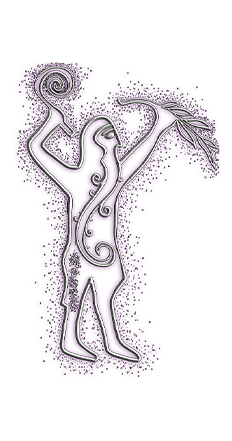
Invocation
(I invoke Aisus)
(Great tender of Drus)
(Celestial woodsman)
(First Druits)
(Maintainer of the cycles of life and death)
(I give offering and thanks to you)
(Offering)
Depictions/Inscriptions
- Pilier des nautes – (CIL XIII, 3026; RIG L2-1) (Depiction with an Inscription) this depiction is him trimming a tree. The tree is thought to be a willow.
- A relief from Treves (Depiction) This depiction is him trimming a tree with a bull and three birds in the tree.
- An Inscription from Cherchell, Algeria AE 1985, 00934 The Inscription says, “Peregrinus [—] | quod Esus fuit iuben[s—]” A rough translation could be “What Esus has commanded.”
Literary Sources
- Lucan’s De Bello Civilo (Pharsalia) I, 498-501
Ligurian tribes, now shorn, in ancient days First of the long-haired nations, on whose necks Once flowed the auburn locks in pride supreme; And those who pacify with blood accursed Savage Teutates, Hesus’ horrid shrines, And Taranis’ altars cruel as were those Loved by Diana (18), goddess of the north; All these now rest in peace. And you, ye Bards, hose martial lays send down to distant times The fame of valorous deeds in battle done, Pour forth in safety more abundant song. While you, ye Druids (19), when the war was done, To mysteries strange and hateful rites returned: To you alone ’tis given the gods and stars To know or not to know; secluded groves Your dwelling-place, and forests far remote. - Marcellus of Bordeaux, De medicamentis liber
“Exucri con-exucri Glion. Aisus scrumio uelor! Exugri con-exugri lau”.
“Run away, go away, sticky thing! Aisus , I want to spit! Run away, go away, evil!” - Lactantius : Divine Institutions , XXI, 3, Translation by: Pierre Monat, 1986, Paris, Cerf
“The Gauls appeased Esus and Teutates with human blood”.
We must remember that the things that the Romans wrote down about him have a political narrative behind them.
I have been wanting to do a small write-up about Aisus for some time but have never gotten around to doing it. The other day I was tending to my land and was moving some stuff around. I took a break and was thinking about Aisus as Casnis, and I was sharing thoughts about him, so I went back to tend as I was thinking about him, I moved the wheel barrel that I moved earlier that day, and an Owl feather was sticking out of the ground, At that moment I knew the Senodruides was speaking to me to write the article. For those that don’t know, I associate owls with the Senodruides. I have an article titled Cauannos of the Druits
Drunemeton
Within Drunemeton Aisus is our Primordial Tender, the first Druits. As he is the maintainer of Drus, which connects all within the cosmos together. He is involved in the creation of the cosmos and the maintainer of it. He shows us how to tend to that which makes up the branches of the cosmos. Shows us the act of sacrifice and in his cyclical nature, teaches us that clearing the old to make way for the new in order for things to flourish is necessary. We need to cut back the branches so that they can become stronger and new growth to happen. By his maintaining, he is also showing us Uissus (wisdom/knowledge) of the Trirextoues. As that is crucial for us to live with and in the thought of that which is sacred.
The Nemeton
The great Nemetons we have are symbolic representations of the first acts after creation, and that is the tending to Drus. Aisus teaches us the act of maintaining our sacred spaces. Not just in a physical sense but also in the spiritual. As we each are leaves on Drus and connected to the vastness of all that is, it is vital that we know when and how to sacrifice and how to tend our own selves for one another so that we can live in a balanced world. Our Nemetons are a central point for worship, and they help us to resonate with the divine energies of the Deuoi. He is our great keeper and tender in our Nemetons.
The Druides
We must remember that a Druið is one who knows Drus. This is someone that studies the deeper layers of the cosmos and its interconnectedness with all that is. These are the thinkers of Drus and keepers of the sacred rites. Aisus is their primordial teacher as they shaped themselves after his actions. So for the Druides, Aisus performs the role of the first Druits. He maintains the cycles and helped to create all within Parios Noibos (The Sacred Cauldron). This is a metaphorical vessel that holds all within the universe. Drus sprouted when the Cintutrîberous came to be. He shows us that with Dêuocariâ (Piety) comes responsibilities to uphold daily. The Druides are the maintainers and, in a way, Priests of Aisus, helping to teach us the mysteries of Drus. With Doniocariâ (Compassion) he shows us that the things we tend to and sacrifice that we need to have compassion in knowing that all is a part of Drus and the cycles of life and death. And with Decos (Honor) he shows us that we must be honorable in our actions toward the sacred, as it is a great honor to be of service to one’s community, Deuoi, and the world around you.
Primordial Tender
The depiction of him on the Pilier des nautes and the Relief from Treves shows what he does, and that is maintaining for renewal. The Bull symbolizes the Earth as our great earth mother Litauia can represent the Bull and her willingness to sacrifice herself for us. As Aisus leads in that sacrifice, the cranes represent the flight of the soul. And the Tree Drus, Aisus, knows that for balance to be maintained that sacrifice is a must. Knowing at the same time that transmigration is happening. Nothing ever dies. It all goes in and from one another. He is the maintainer of the cycles of life and death, representing the shifting of Samos to Giamos and vice versa. We see him with a cultivating tool, as this tool is also symbolic for us as the sacred tool that maintains the universe, so as a Druið, we use this tool to symbolize the cultivator within us to gather our sacred herbs and to keep our Nemetons clear and clean in both the physical and spiritual.
The Bardoi
The Bardoi are crucial to deepening a greater understanding of all this. In time they will help to connect all these thoughts into one of Drunemetons first Myths. Once this myth is created, we will reconstruct the Druið Mistletoe rite that Pliny talks about. Within that myth, you can see a lot of resemblance to the thought of Aisus and the first acts after creation within it.
Our Bardos Casnis has some amazing art and words on Aisus at Below the woods. Please also check that out as they go into other details regarding him.
In the Sky
For those that want to gaze up into the sky, you can see Aisus reenacting the first sacrifices in the constellation of Orion and Taurus. He can be seen from January to April in the Northern Hemisphere. The Pleiades play an important role also within Drunemeton. You can find some thoughts here.
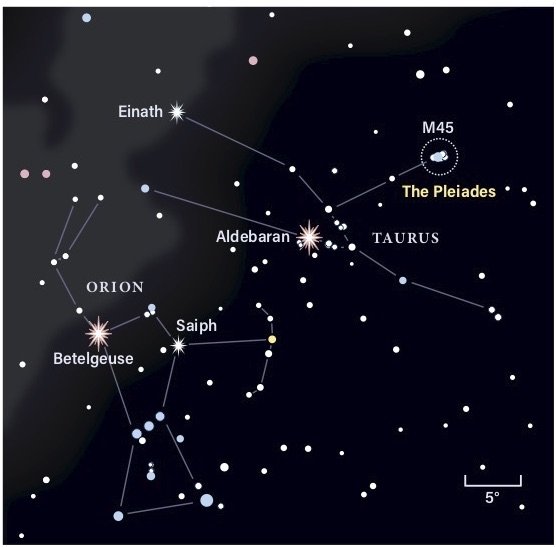
Orion = Aisus
Taurus = The Bull, Tarvos Trigaranus
Pleiades = The Cranes
The Tree = The Universe
The teaching within the Nemeton
The act of pruning signifies the necessity of sacrificial action and the cyclical nature of life and death. Just as the tree needs to be pruned for new growth and vitality, sacrifices and offerings are made to honor the cycles of existence and ensure the continuation of life. This act of piety and reverence for the sacred is an essential aspect of the role of Aisus as the caretaker and Deuos of the world Tree. Tarvos Trigaranus, the sacrificial bull, serves as a symbol of courage and strength in the face of life’s challenges and uncertainties. Bulls are often associated with virility and fertility, representing the life force and vitality that flows through the natural world. Through the sacrifice of the bull, the cosmic order is maintained, and the sacred bond between the mortal and divine realms is reinforced.
Aisus and Tarvos Trigaranus work in harmony, representing the interplay between human action and the forces of nature. Aisus with his wisdom and understanding of the cosmic cycles, tends to the World Tree, while Tarvos Trigaranus, through its sacrifice, participates in the perpetuation of these cycles. Together, they embody the timeless wisdom of the natural world and the sacred relationship between the earthly and divine realms. This serves as a reminder of the interconnectedness of all life and the importance of living in harmony with nature, embracing both the joyous and challenging aspects of existence.
I would like to note that Aisus does not sacrifice the bull himself. Instead, the bull and the three cranes, Tarvos Trigaranus, represent sacrifice. The bull embodies the idea of a sacrificial offering and serves as a symbol of piety, courage, and continuity within the context of the cosmic cycles of life and death. As the caretaker of the World Tree and guardian of the cycles of life and death, Aisus recognizes the importance of the bull’s role as a symbol of sacrifice. He understands that sacrifice, in its true essence, is not merely about the act of offering something but rather about embracing the natural rhythms of existence. The bull’s presence highlights the concept of sacrifice as an inherent part of the cosmic order. It emphasizes the cyclical nature of life, where every ending leads to a new beginning, and every sacrifice contributes to the continuity of existence. As the wise and enigmatic deity, Aisus guides the hunter and the mortals to understand the significance of sacrifice and how it is intertwined with the balance and harmony of the universe.
The bull’s death represents the inevitability of mortality and the transformative power of sacrifice. Just as the tree needs to be pruned to facilitate new growth, the bull’s sacrifice becomes a catalyst for regeneration and renewal. This act of sacrifice serves as a profound symbol of the interconnectedness between life and death, and the notion that from death springs new life. The cranes, as agents of regeneration, play a vital role they represent the cycle of rebirth and the transcendence of death. In various cultures, cranes are often associated with longevity, wisdom, and transformation. The cranes’ act of bringing the bull back to life symbolizes the eternal cycle of regeneration and the continuity of life beyond the boundaries of mortality.
As this reminds us of the inevitability of change, the necessity of sacrifice, and the potential for transformation and renewal. Like the bull and the tree, we too undergo cycles of growth, death, and rebirth throughout our lives. Through these experiences, we learn the importance of moderation, perseverance, and wisdom in navigating the complexities of existence.
Aisus teaches us that sacrifice is not about blindly giving up something but about recognizing the greater purpose and meaning behind each act. The bull’s symbolic representation as a sacrificial offering helps us comprehend the wisdom of moderation, perseverance, and reverence for the interconnectedness of all life. By respecting the sacredness of the bull and understanding its role in the cosmic dance of life and death, we learn to live in harmony with the natural order. As the celestial woodsman and guardian, Aisus exemplifies the need to tend to the delicate balance of the world, ensuring that sacrifice is not misused or undertaken without due consideration.
Note
We will go much more in-depth with Drus later on; these thoughts here do not represent those of the Contemporary Druid orders or the greater Gaulish community. They represent the thoughts within Drunemeton.

 The Witch's and Druids Den
Leave a reply to Aisus — The Carnutian Nemeton | Die Goldene Landschaft Cancel reply