


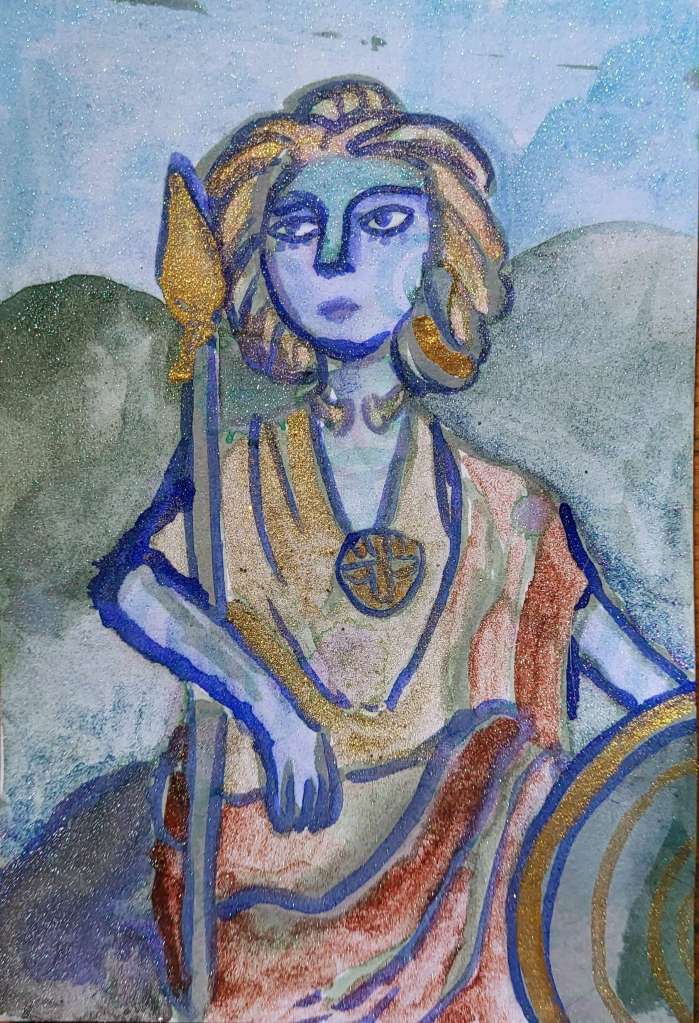
The Great Guardian who overwatches from high above, protecting our homes, sanctuaries, cities, and meeting grounds. She is always at the ready to give victory with her piercing spear to defeat those that would do us harm. She has bestowed upon us the strategic knowledge of warfare and Justice so that we also may aid in protecting our gathering and resting places. Some even say that if you peer close enough into the fire of the hearth, you can hear her voice within.
Carnutos
Art by Below The Wood
Brigindû, the Great Guardian who watches from above, is a goddess with deep mythological elements and multifaceted associations. Her name, meaning “the High One,” derives from the Gaulish root “brigant–” meaning “high” or “elevated,” also seen in toponyms meaning “hill” or “fortress.” This evokes images of elevated landscapes like hilltops and mountains where forts would be lit by the burning forges of the smiths and signal fires by the warriors warning of incoming trouble. This connection suggests her role as a Guardian Dêuâ (Goddess). Many rivers, hillforts, and tribes were named in her honor all throughout the lands of the ancestors. If we draw parallels to a few goddesses in neighboring lands while also looking at the inscriptions provided below, we can illuminate much more about her.
Inscriptions
Gaul
- Inscription of Auxay (CIL 13, 2638)
ICCAVOS OPPIANICNOS IEVRV BRIGINDONI CANTALON
Iccavos son of Oppianos offered the canton to Brigindu (-ona?).
By X. Delamarre
Britain
- Adel, Britain (RIB 630)
Deae Brigan(tiae) d(onum) Cingetissa p(osuit)
To the goddess Brigantia, Cingetissa set up this offering. - Castleford, Britain (RIB 628)
Deae Victoriae Brigant(iae) a(ram) d(edicavit) Aur(elius) S enopianus
To the goddess Victoria Brigantia Aurelius Senopianus dedicated this altar. - Birrens, Britain (RIB 2091)
Brigantiae s(acrum) Amandus arc(h)itectus ex imperio imp(eratum) ( fecit)
Sacred to Brigantia: Amandus, the engineer, by command fulfilled the order. - Corbridge, Britain (RIB 1131)
Iovi aeterno Dolicheno et Caelesti Brigantiae et Saluti G(aius) Iulius Ap|olinaris (centurio) leg(ionis) VI iuss(u) dei
To eternal Jupiter of Doliche and to Caelestis Brigantia and to Salus Gaius Julius Apolinaris, centurion of the Sixth Legion, at the command of the god (set this up). - Greetland, Britain (RIB 627)
D(eae) Vict(oriae) Brig(antiae) et Num(inibus) Aug(ustorum) T(itus) Aur(elius) Aurelian|us d(edit) d(edicavit) pro se et suis s(e) mag(istro) s(acrorum) Antonin[o] et Geta co(n)s(ulibu)s
To the goddess Victoria Brigantia and to the Divinities of the two Emperors, Titus Aurelius Aurelianus gave and dedicated (this altar) for himself and his family, while he himself was master of sacred rites, in the third consulship of Antoninus and the [second] of Geta. - Hadrian’s Wall, Britain (RIB 2066)
Deae Nymphae Brig(antiae) quod [vo]verat pro sal[ute et incolumitate] dom(ini) nostr(i) Invic(ti) imp(eratoris) M(arci) Aurel(i) Severi Antonini Pii Felic[i]s Aug(usti) totiusque do|mus divinae eius M(arcus) Cocceius Nigrinus [pr]oc(urator) Aug(usti) n(ostri) devo [tissim]us num[ini] [maies]tatique eius v(otum) [s(olvit)] l(aetus) l(ibens) m(erito)
This offering to the goddess-nymph Brigantia, which he had vowed for the welfare and safety of our Lord the Invincible Emperor Marcus Aurelius Severus Antoninus Pius Felix Augustus and of his whole Divine House, Marcus Cocceius Nigrinus, procurator of our Emperor and most devoted to his divinity and majesty, gladly, willingly, and deservedly fulfilled. - South Shields, Britain (RIB 1053)
Deae Bri|gantiae sacrum Congenn(i)c cus v(otum) s(olvit) l(ibens) m(erito)
Sacred to the goddess Brigantia: Congennicus willingly and deservedly fulfilled his vow.
She is portrayed with a spear, a “globe of victory,” and a gorgon’s head on her chest, bringing to mind the iconography of Menerva. The Etruscan Menerva her name stemming from an Italic moon goddess *Meneswā (‘She who measures’), is one of the Twelve lightning-throwing gods. From the different offerings found, we know that she was an educator and loved by the people. The Roman Minerva, the Goddess of the arts, wisdom, strategic war, and crafting, who is often likened to Athena, the patron deity of Athens associated with war and strategy, adds another layer to her.
Inscriptions using the term “Caelestis” meaning celestial or heavenly, suggest she has a place in the heavens, (perhaps calling back to an older function of her being a moon goddess?), and her likening to Victoria further enhances her divine qualities. Additionally, she shares similarities with Themis, in my opinion, Themis is the personification of justice, divine order, law, and custom. In Britain, Brigindû served as the tutelary Dêuâ of the Brigantes tribe, known as Brigantiā.
Her depiction with a spear showcases her martial prowess and authority, reflecting her status as a warrior goddess. The presence of the globe of victory further accentuates her connection to triumphant outcomes in battle. Notably, the inclusion of a Gorgon’s head on her breastplate draws inspiration from the imagery of Minerva and Athena, powerful goddesses associated with protection and wisdom. This symbolism infuses Brigindû with a multifaceted presence, representing both her defensive and strategic aspects. Her connection to fire brings to mind different aspects of the fires of creation and the fires of destruction, that being the fires from the cosmos and the forge. These deep elements combined, I see a goddess associated with Fairness, Protection, Balance, Justice, Truth, Integrity, Victory, Law, Decision-Making, Accountability, Arts, Statgic War, Divine Order, Impartiality, Cause and Effect, Legal Matters and Contracts. She is a firm and fierce protectress, guiding and instructing us in the ways of war, law, and justice. Upholding that justice through her role as a guardian and protector ensuring us that proper procedures and right customs are followed. She not only guards and protects, but also upholds the principles of fairness and balance in the world. Overseeing our social order and acting as a divine arbitrator, weighing the scales of truth and impartiality. In her role as a goddess of victory, Brigindû ensures that triumph is achieved through just means, with integrity and accountability. As a celestial Dêuâ, her commitment to preserving harmony and safeguarding her devotees aligns with the ideals of divine order and cosmic balance bestowing upon us Dedmis (sacred law). Her fires and lightning bring order, creativity, and balance. She is the Great Uolcos (Falcon) Guardian (Falcons are known for being protective and territorial). So whenever you see a Uolcos fly by, she is the guiding force letting you know she is always around watching.
The Flame of Dedmis
The idea of Dedmis, for me, is a Gift from Brigindû , which comes from Triuradiā Conuextion within Drunemeton

Dedmis encompasses proper procedures, the right customs, social order, and the divine will as revealed through omens. The term “Dedmis” finds its roots in the Greek word “Themis,” who was a Titan in Greek mythology. The literal meaning of “Themis” is “that which is put in place.” In Greek mythology, Themis was associated with divine law, justice, and the order of the cosmos. She was often depicted as a wise and fair goddess who maintained harmony and upheld the natural order. Themis represents the principles of justice, law, and custom, and her name became synonymous with the concept of divine order. ,
Dedmis comes from Brigindû and signifies the sacred laws and principles that govern human behavior and society. It emphasizes the importance of adhering to proper procedures, following the right customs, and maintaining social order as ordained by the Gods. Additionally, Dedmis recognizes the role of divine intervention and omens in revealing the will of the Gods and guiding human actions. Dedmis represents the sacred law bestowed upon humanity by the Gods, which encompasses the principles of proper conduct, social order, and the divine will. Its origins in the word Themis highlight its connection to the concept of divine law and the establishment of harmonious relationships within society.
The Flame of Brigouelon

Sitting with her for many moons now, I have been slowly listening to her teachings that whisper to me from time to time, I have encountered the
concept of Brigouelon, a concept rooted in the commanding view from a mountaintop. It symbolizes self-control and the refusal to allow external forces to dictate our perspective. Often, others can influence our perception of the world and ourselves, relinquishing control over our own views. Brigindû, the Great Guardian who watches from above, equips us with the wisdom and knowledge of warfare, not only in external conflicts but also in the internal struggles we face. She provides us with the tools to assert sovereignty over our own perspectives, embodying the commanding view of Brigouelon. By cultivating self-control and fortitude, Brigouelon allows us to conquer negative emotions and align our will with nature’s universal reason. Its fundamental aim is to enhance our ethical and moral well-being, recognizing that virtue lies in aligning our will with the natural order of things. Embracing Brigouelon enables us to stand tall, commanding our own paths and shaping our own destinies.
Brigouelon encourages us self-discipline and resilience, empowering us to conquer the internal battles that often plague us. By gaining mastery over our thoughts and emotions, we become clear and unbiased thinkers, capable of comprehending the universal reason that governs the world. Through this understanding, we strive to improve our ethical and moral well-being, aligning ourselves with the principles of nature and living in harmony with the cosmic order.
By embodying her attributes, we become protectors, defenders, and advocates for what is right and just.
In the flame of the hearth, we may catch a whisper of her voice, a reminder of her presence and guidance. Let us heed her call and strive for the commanding view, standing firm in our principles, protecting what is dear, and fostering a world governed by virtue and harmony.
The Flame of Ianoi (Virtues)

The Four Fires of Brigindû
Courage
Brigindû emphasizes the virtue of courage. She inspires us to face challenges head-on, both in external conflicts and in the internal struggles we encounter. With this we can overcome obstacles, protect what is important to us, and uphold justice.
Justice
Brigindû is the personification of justice, divine order, law, and custom. This is the importance of fairness and upholding moral principles. Embracing justice involves treating others equitably, advocating for what is right, and striving for a harmonious and just society.
Self-Control
Brigindû encourages self-control and fortitude. It calls us to master our emotions and thoughts, enabling us to overcome negative impulses and align our will with the natural order. Self-control allows us to make rational decisions and maintain inner harmony.
Wisdom
Brigindû gives wisdom a vital virtue associated with making sound judgments, seeking knowledge, and gaining a deeper understanding of ourselves and the world. With wisdom, we can make informed choices, navigate complexities with clarity, and cultivate a deeper connection with the universal reason.
The Legend of the Flame of Brigindû

Once, a serpent of unfathomable chaos slithered across the land, leaving barrenness and despair in its wake. Wherever it passed life withered and growth was halted. The people suffered under the serpent’s oppressive reign, unable to flourish or find solace in their surroundings. Witnessing the plight of her people, Brigindû, the Great Guardian and Goddess of Divine Order, emerged from the celestial realm of Albios,. Adorned with a great spear, she bore the weight of responsibility for restoring balance and harmony.

A mighty battle ensued between Brigindû and the serpent, a clash of opposing forces that shook the very foundation of the land. With unwavering courage and unyielding determination, Brigindû confronted the serpent’s chaos and darkness, engaged in a cosmic struggle for the soul of the realm.
Finally, after a fierce and arduous conflict, Brigindû emerged triumphant. With a mighty blow of her spear and the summoning of her fire of Dedmis, she struck down and engulfed the serpent, purifying its essence and transforming it into a symbol of harmony and balance. Releasing the land from its malevolent grip. The once barren soil began to stir with new life, and the people rejoiced as hope bloomed like spring flowers.
Yet, Brigindû knew that victory alone was not enough. To ensure lasting harmony and prevent the resurgence of chaos, she summoned the Source Fire of Dedmis, the embodiment of sacred law and divine order. From this sacred fire, she drew forth her teachings, kindling the flame within the hearts of her people.
Gathering the people around the sacred fire, Brigindû imparted upon them the profound wisdom of the Four Flames of Virtue: Courage, Justice, Self-Control, and Wisdom. These virtues would serve as beacons of light, guiding the people towards a path of righteousness and harmonious living.
With the Flame of Courage, the people learned to stand firm in the face of adversity, finding strength within themselves to overcome challenges and protect what they held dear. The Flame of Justice guided their actions, ensuring fairness, equity, and the upholding of righteous principles in their society.
Through the Flame of Self-Control, the people discovered the power of discipline and restraint, tempering their desires and impulses to maintain inner harmony and balance. And with the Flame of Wisdom, they attained profound insights and discernment, illuminating the path of knowledge and guiding their choices with clarity.
As the people embraced these Four Flames of Virtue, the land transformed. Where once barrenness prevailed, lush meadows and thriving forests emerged. Communities flourished, their bonds strengthened by justice, and their actions guided by wisdom. The people lived in harmony, their lives enriched by the sacred law of Dedmis.
In honor of Brigindû’s victory over chaos, the people established a sacred holiday known as the Day of Divine Order. On this day, they gathered to celebrate the triumph of justice and the power of divine intervention. They offered prayers and thanks to Brigindû, acknowledging her as the guardian of order, law, and righteousness.
Through the ages, the Flame of Dedmis continued to burn brightly, a testament to the victory of divine order over chaos. The people honored Brigindû as their guardian and teacher, forever grateful for the sacred fire and the wisdom she bestowed upon them.
And so, the legend of the Flame of Dedmis endured, reminding generations to come of the transformative power of virtue and the importance of upholding the sacred laws. It stood as a testament to the resilience of humanity and the everlasting triumph of divine order, ensuring that the land would forever flourish under the guiding light of the Four Flames of Virtue.

The Holiday – Day of Divine Order
The Day of Divine Order celebrates the triumph of harmony and balance, occurring after the spring equinox. It signifies the transition from chaos to order, Giamos to Samos, and is observed during the first sight of the full moon after the Condergā (spring equinox). The spring equinox marks the beginning of rejuvenation and balance, as nature awakens with new life. By aligning the holiday with this season, it embodies transformation and the victory of order over chaos, reminding us of the power of divine intervention. During this time, we honor Brigindû, express gratitude, and reinforce fairness, justice, and balance through rituals. It is a time for reflection and recommitment to Dedmis and the Four fires of Virtue. As spring unfolds, we engage in activities symbolizing growth, like planting seeds and acts of kindness, fostering harmony in our communities. The Day of Divine Order reminds us to uphold sacred laws and principles, celebrating the triumph of order and justice.
Words for Brigindû

Brigindû, High One, Goddess of Protection and Victory, we honor your divine presence and humbly seek your guidance. With your boundless wisdom and unwavering strength, may we transcend the trials that come our way, conquer the conflicts within ourselves, and uphold the noble principles of justice, order, and self-mastery.
As the embodiment of righteousness, you inspire us to strive for excellence in all aspects of our lives. You are the shield that guards us in times of adversity, the beacon of light that guides us towards the path of truth and virtue. We look to you as our guiding star, illuminating our way as we navigate the complexities of existence.
In your presence, we find solace and courage, knowing that you are a steadfast guardian, watching over us with unwavering devotion. Your divine protection is a shield that shields us from harm, enabling us to face life’s challenges with resilience and determination.
We beseech you, Brigindû, to bless us with your divine favor and empower us to be agents of positive change in the world. Grant us the strength to stand up for what is right, the wisdom to make just decisions, and the fortitude to overcome obstacles on our journey towards self-mastery.
As we honor you, Great Goddess, we pledge our unwavering commitment to upholding the values of justice, order, and self-mastery in our lives and in society. With your blessings, we strive to create a world where fairness reigns, where the weak are protected, and where victory is achieved through noble means.
Brigindû, High One, Goddess of Protection and Victory, we offer our gratitude and reverence. May your divine presence guide us on our path, and may your unwavering strength empower us to manifest justice, order, and self-mastery in all that we do.
Note
- The above thoughts are my own personal views and do not represent the whole of Gaulish Paganism.
- Information was pulled from.
- The Gods of the Celts and the Indo-Europeans – Garrett Olmsted
- Themis, A study of Social Origins of Greek Religion – Jane Harrison
- Etruscan Life and Afterlife -Larissa Bonfantee
- Celtic Goddesses – Miranda Gree
- The Dictionary of Celtic Mythology – James MacKillop
- The Computerized Compendium of Gallic Inscriptions RIIG
- Epigraphik-Datenbank


 The Witch's and Druids Den
Leave a comment