
Carvonia: Goddess of Ecstatic practices
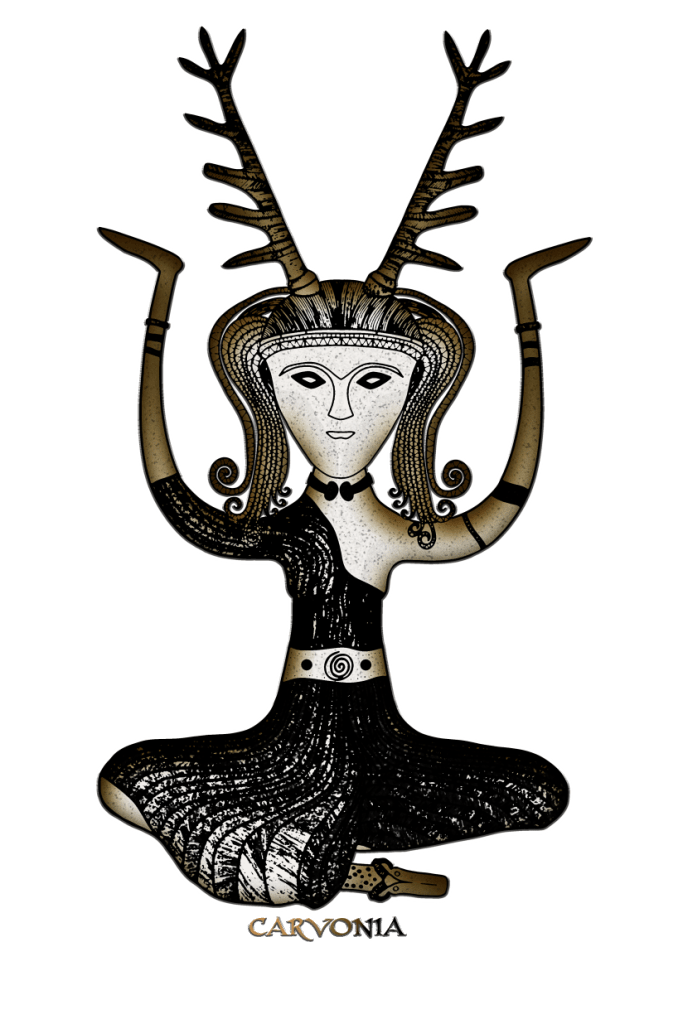
Among the many deities that may have once graced the sacred groves of the Gauls, one name echoes in the rustling of leaves and the swift movement of hooves through the mist—Carvonia. Her name calls forth deep symbolic meaning, drawing from the Gaulish root Carvo-, meaning “deer” or “stag.” Thus, “Carvonia” can be interpreted as “She of the Deer” or “Deer Goddess,” reflecting her role as a divine embodiment of the deer and its associated attributes. The idea here like most of my articles, they are not to paint the way the ancestors seen rather it is to remove the dust so that we can see today. So with that Carvonia emerges to me as a goddess of Ecstatic practices, wild places, liminality, and of the sacred dance between the seen and unseen realms.
Inscriptions
- Dobrteša vas, Slovenia (C.I.L. III: 5115)
- Sacred to the August Carvonia for the safety of C[n.?] Atilius Iulianus
- [Ca]rvoniae Aug(ustae) sacr(um) p[r]o salute C[n.] Atili Iuliani
- San Esteban de Gormaz, Spain (CIL II 2857)
- To Carvonia, Gnaeus Atilius Julianus fulfilled his vow willingly and deservedly.
- CARVONIAE / GNAEUS ATILIUS / IULIANUS VOTUM / SOLVIT LIBENS MERITO
- San Esteban de Gormaz, Spain (AE 1991, 1077)
- Sacred to Carvonia, [name missing] fulfilled his vow willingly and deservedly.
- CARVONIAE / SACRUM / [—] VOTUM / SOLVIT LIBENS MERITO
These inscriptions suggest that Carvonia’s worship was present in the region corresponding to modern-day Spain, all the way to the Noricum region (Present day Slovenia). This truly shows us the widespread nature of her veneration. There are no other known inscriptions explicitly dedicated to Carvonia. However, deer and stag iconography are widely attested in Gaulish material culture, often suggested to be associated with liminality and divine power (Green 1988). We have found representations of antlered goddesses notable among these is a bronze statue discovered in Besançon (Doubs), now housed in the British Museum, and another from Puy-de-Dôme, currently in the Musée de Clermont-Ferrand. The Besançon bronze depicts a seated female figure adorned with antlers, holding a cornucopia and a patera, symbols often associated with abundance and ritual offerings. This iconography can suggest a goddess embodying both the nurturing aspects of nature and its untamed, liminal qualities. The presence of antlers, typically a male attribute, on a female deity shows us the possible fluidity of gender roles within Gaulish “mythology” and shows us the goddess’s dominion over the thresholds between the civilized and the wild in some aspect’s. The image of an antlered goddess ties her to both Ecstatic Practices and fertility symbolism. Antlers have long represented strength and connection to the wild. Unlike horns, which stay fixed, antlers are shed and regrown, reflecting the cycles of life, death, and rebirth.
In Gaulish tradition, antlers are usually tied to Carnonos. But there’s good reason to believe they were also linked to female figures. Carvings of antlered goddesses have been found across Europe, suggesting that this imagery belonged to female deities also. Numerous depictions of stags and antlered figures appear across Gaulish religious artifacts, such as the famous Pillar of the Boatmen, where Carnonos sits or the Great Gundestrup Cauldron or even the cave paintings found in the lands of Gaul the significance of cervid symbolism in Celtic spirituality is strong (Rolland 1990).


Into the Comparative
Carvonia’s attributes seem to align closely with deities such as the Irish Flidais, a goddess associated with deer and the hunt, and the Roman Diana, mistress of the wilderness and liminality (Aldhouse-Green 1997). Additionally, the stag has been linked to Ecstatic practices in both Indo-European and indigenous European contexts, often serving as a guide between realms (Serith 2007). She may also be compared to the British Elen of the Ways, a mysterious antlered goddess linked to pathways, sovereignty, and the guidance of travelers (Johnston 1995). Like Elen, Carvonia could represent movement, protection, and the liminality of the wild. Echoes of her presence may be found in the many horned goddesses or women of prehistoric Europe, where cervid imagery was sacred and intertwined with female deities of the hunt and fertility (Hutton 2013).
I have a feeling that Carvonia is not a true Proto-Indo-European (PIE) deity, but rather belongs to the specific cultural and spiritual traditions of European groups during the Paleo period. Given this, comparative analysis with other PIE deities can only provide limited insight into her character and significance. Instead, we may find a clearer understanding of Carvonia by considering the broader context of women in early European spiritual and healing traditions.
Archaeological evidence suggests that women in early Europe were deeply connected to spiritual and ritual practices, with certain artifacts and burial findings pointing to their roles as mediators between the human and spiritual realms. One key example is the antlered headdress found at Bad Dürrenberg (Germany) dating to the Mesolithic period. This item, likely associated with ceremonial use, suggests a connection to the Horned God/dess or animal spirits, marking the wearer’s involvement in spiritual practices or rites of passage. At Star Carr in North Yorkshire, 21 antlered headdresses were found, also dating to the Mesolithic period. While it is uncertain whether these belonged specifically to women, the presence of such items is significant. They could indicate that women, or at least important spiritual figures, used horned headgear to embody connections with the divine or animal realms. Another crucial find comes from Skateholm in Sweden, where a Mesolithic burial (Burial XXII) revealed a woman described as the “Seated Woman.” She is depicted wearing a feather cape, a slate necklace, and a belt made of 130 animal teeth. Most notably, she was seated cross-legged on a “throne” of deer antlers. This extraordinary burial context indicates that the individual was a person of spiritual or ceremonial importance, with the deer antlers suggesting a symbolic connection to nature, fertility, and animal spirits—possibly even an Ecstatic role.
These examples show us the role of women as spiritual leaders and healers, with antlered headgear and animal symbolism playing key roles in their Ecstatic or divinatory practices. While it remains unclear whether Carvonia is directly tied to these traditions, her association with such imagery and spiritual roles is certainly a possibility within the context of early European female deities or spiritual figures.
In various cultures across Europe, roles such as the ancient Irish ban feasa (woman of knowledge), ban leighis (woman of healing), the Gaulish Uâtis (the Mantic One—seers and healers), Norse Völvas (women with spiritual authority and seers), and many other titles, trace an older worldview that honored the spiritual and healing roles of women. Sadly, as new worldviews emerged, these roles were often diminished, with the growing influence of more patriarchal systems pushing women out of spiritual leadership positions. These terms, though differing in language and region, share several common themes. They refer to women who not only had knowledge of herbs and remedies, but also conducted healing rituals and provided divinatory insights. These women often served as intermediaries between the human and spiritual realms, playing a crucial role in guiding their communities. Whether through their herbal knowledge, ritual practices, or spiritual insights, women in these roles were integral to the well-being of their communities, serving as conduits to both the divine and the natural world. Despite the passage of time and the dominance of new religious structures, the ban feasa, ban leighis, Uâtis, and Völvas stand as symbols of a time when women held powerful, respected positions as spiritual leaders and healers—a reminder of the balance that once existed between the physical and spiritual, and the vital roles women played in maintaining that harmony.
These women functioned as mediators, utilizing their wisdom and spiritual authority to maintain balance, not only within the human sphere but also in relation to the unseen forces that shaped their world. This can suggest that Carvonia, if related to these roles, may reflect an archetype of feminine wisdom, healing, and divination that spans various European traditions, grounded in an understanding of women’s spiritual power and connection to the natural world.
The Nature of Carvonia
Now that we have covered some of the academic side we can now take a closer look at her.
Carvonia is a deity of transitions, much like the deer that swiftly navigates the boundary between forest and field, light and shadow. She is a guide for those who walk between worlds—hunters, travelers, seers, and those in search of wisdom hidden within nature’s embrace. Just as the stag sheds and regrows its antlers, Carvonia teaches the lessons of renewal, the cyclical nature of life, and the necessity of embracing change. Antler shedding reflects the spiritual process of releasing the old to make way for the new—a sacred act of transformation. This natural rhythm mirrors the journey of the soul, where growth comes through surrender and regeneration. She is the cycle of the seasons and the fertility of the those seasons as she is deeply associated with fertility, the land, and agriculture ( For me hunter gather form of agriculture). She is seen as a goddess of the earth’s natural cycles, governing the rhythms of growth, decay, and renewal. Her presence is felt in the turning of the seasons, the sprouting of seeds, and the bountiful harvest that sustains life. Symbolically, she represents the harvest and the life-giving properties of the land. As a goddess of abundance, she is the nurturing qualities of the earth, ensuring the fertility of the soil and the prosperity of those who depend upon it. Her connection to cervids, animals that traverse vast distances and renew themselves through the cycle of antler shedding, further links her to the regenerative forces of nature.
In many traditions, the act of the “Divine Hunt” plays a crucial role in sustaining life. The sacrifice of the wild animal ensures the renewal of the earth, a sacred exchange between the realms of nature and spirit. This theme goes along with Carvonia’s essence—she is both the gentle provider of nourishment and the sovereign of the untamed wilds, where death and rebirth are intertwined.
Antlers not only represent cycles of renewal but also embody themes of travel and divine madness. During the rut, cervids journey across vast landscapes, driven by a singular, almost otherworldly purpose. This relentless movement reflects the spiritual quests found in Celtic mythology, where heroes traverse between worlds guided by stag symbolism. Her connection to antlers speaks to hidden insight into the Otherworld. Just as Carnonos is a liminal god who stands at the threshold between realms, Carvonia’s essence carries the untamed wisdom of the wild. Antlers serve as conduits of divine knowledge, much like the Ecstatic traditions where cervids act as guides, leading seekers through mystical experiences and altered states of consciousness.
Her symbols and Sacred Aspects
Carvonia’s domain is that of the forest, the rivers, and the open spaces where the wild breathes freely. Her primary symbol is the stag.
- The Deer/Stag: Messenger of the wild, guide between realms, embodying grace and strength.
- Antlers: Representing cycles of growth, renewal, and the ability to connect with the divine.
- Running Water: Symbolizing movement, transition, and the passage between.
- Mist and Shadow: Her presence often felt in the quiet moments of dawn and dusk, the threshold between light and darkness.
- Horned Serpent: The guide into ecstatic practices, the holder of the mysteries of Antumnos (The Otherworld).
Forested spaces and riverbanks are her sacred places, where one may listen for her voice in the wind or sense her presence in the stillness of the trees. Diviners may call upon her to aid in visions and omens, seeking insight from the paths that deer travel, the shifting patterns of the forest, or the movement of water through the land. She may also be invoked during times of personal transition—whether stepping into a new phase of life, crossing between the physical and spiritual realms, or embracing the mysteries of the unknown.
Carvonia is a guardian of change and renewal. She is both the gentle doe that offers comfort and the mighty stag that challenges the seeker to grow. To follow Carvonia is to embrace the unknown, to trust the path beneath one’s feet, and to recognize that, like the deer, we are all travelers, moving ever forward in the grand cycle of existence. Those who listen may yet hear her call—the whisper of hooves in the twilight, the song of wind through antlers, the silent gaze of the forest watching, waiting, guiding. Carvonia’s antlers teach us that life isn’t a straight path. There’s shedding and regrowth, death and renewal. The deer’s antlers fall away, but they always return. Carvonia also teaches us about the seasons of life—not just the ones we see in nature, but the ones we face in ourselves. She is the wildness that comes after the harvest and the quiet stillness before the thaw. She moves through the liminal spaces, guiding us through the turning of the wheel. To walk with Carvonia is to walk with the cycles of nature, knowing that even when things fall away, they are never truly lost. Her presence is subtle, fleeting—a glimpse of white in the underbrush, the soft imprint of a hoof in the damp earth. Yet to those who seek her, she is ever-present, waiting at the edge of perception, ready to lead the way into the deeper mysteries of existence.
Hail Carvonia, Lady of the Liminal Wilds, Guardian of the Sacred Stag!
Note
Carvonia could have been an older goddess by other names, and over time, the male aspect of this symbolism took prominence, phasing out the female. Alternatively, they could have emerged together, as we see many Paleolithic examples of the Horned/Antlered Deity. In essence, they do not seem to be much different from one another, both representing the untamed power of nature and the spiritual bridge between realms.
Sources
Aldhouse-Green, Miranda. Celtic Goddesses: Warriors, Virgins and Mothers. Routledge, 1997.
Green, Miranda. The Gods of the Celts. Sutton Publishing, 1988.
Hutton, Ronald. Pagan Britain. Yale University Press, 2013.
Johnston, Richard. Elen of the Ways: A Study of Britain’s Hidden Goddess. Moon Books, 1995.
Rolland, Henri. Le Pilier des Nautes. Gallimard, 1990.
Serith, Ceisiwr. A Book of Pagan Prayer. Weiser Books, 2007.
 The Witch's and Druids Den