


Welcome, my fellow seekers! Let us take a walk into the Greenwood, where whispers of ancient trees and the melodies of rushing streams guide us to our first tale of the Greenwood Pantheon. Here, beneath the dappled sunlight and the canopy of eternal oaks, we will uncover a story that bridges the mortal and the divine. This tale is one of calling and communion, of virtue and reciprocity, where the wilds become a sacred space for transformation. Together, we’ll step into a world where the gods are not distant but present, living and breathing through the untamed heart of nature.
Myths of gods and goddesses often draw us into deep reflection, offering profound insights into the mysteries of existence. Yet, divinity isn’t confined to lofty tales—it weaves through every thread of the Cosmos. For me, the sacred is found not only in myths but in the stories of devotion, the call of the wilds, and the way nature itself offers us answers. This tale speaks to those timeless truths: the sacred bonds with the untamed world, the virtue of hospitality that welcomes all, and the practice of reciprocity—the art of giving and receiving in balance. Paganism teaches us to see the divine in the everyday—in the choices we make, the connections we cherish, and the way we walk through life with reverence. This story reflects that sacred rhythm, reminding us of the beauty in the relationships we forge with both the seen and unseen worlds.
Robin Hood is often celebrated as a hero of justice, a noble outlaw who stole from the rich to give to the poor. His tales are rich with adventure, camaraderie, and defiance of unjust authority. Yet beneath the surface, these stories can resonate with deeper spiritual themes, many of which align with pagan values. One such tale, A Gest of Robyn Hode, offers a lens through which we can explore ideas of reciprocity, sacred spaces, and the interconnectedness of life.
This story is more than a medieval ballad—it’s a reflection of timeless values and a reminder of the sacred bonds between individuals and their communities, as well as between humans and the natural world.
Robin Hood, a noble-hearted outlaw, is seated deep in the green sanctuary of Sherwood Forest. That morning, he had heard three Masses to honor the divine, including one for the Virgin Mary, to whom he held deep devotion. His stomach growls, but Robin refuses to eat without a guest at his table. Sending his men out into the wild, he tells them to harm none who live humbly but to seek their bounty from bishops, archbishops, or the Sheriff of Nottingham. Out in the streets of Barnsdale, Little John and his companions come across a knight who seems weighed down by the world. His face is marked by sorrow, his posture stooped under an invisible burden. They bring him to Robin, who greets him not as a stranger, but with the respect owed to an equal. Robin’s men prepare a fine feast—bread, wine, venison, and roasted birds of the river—and the knight is invited to dine. As they eat, Robin inquires about the knight’s troubles, moved by his weathered clothes and sorrowful gaze. The knight reveals his story: his son had slain another, and to pay the blood price, the knight borrowed 400 pounds from the Abbot of St. Mary’s, pledging his lands as collateral. Now, the loan is due, and with only ten shillings to his name, he faces ruin. Robin listens with care, and seeing the knight’s honesty, he does something remarkable. He retrieves 400 pounds from his hidden treasury and gifts it to the knight, declaring that the Virgin Mary herself stands as collateral. He doesn’t stop there; he outfits the knight with new clothes, a fine horse, and even offers Little John as a companion to ensure safe travels. The knight, filled with gratitude, promises to return and repay this kindness—a promise he keeps.
A Gest of Robyn Hode: First Fytte
A Story Rooted in Pagan Wisdom
While the tale speaks openly of Christian faith, its heart beats with themes that echo pagan values. The forest is not just a setting; it is a sanctuary, a sacred place where mortals seek answers and solace, much like a grove or holy site in pagan traditions. Robin Hood himself feels more like a guardian spirit than a man—someone who upholds justice, protects the vulnerable, and restores balance. His actions reflect the qualities of a deity or nature spirit, reminding us of the sacred duty to help those in need. The knight’s humble plea for aid mirrors the way a person might approach the gods in pagan practice. He comes with honesty and without pride, and in return, he receives not just help, but renewal. Robin’s generosity, in turn, mirrors the sacred exchange of offering and blessing—a core practice in pagan spirituality. Even Robin’s devotion to the Virgin Mary can be seen through a broader lens. She carries echoes of the divine feminine found in many pagan traditions: a source of mercy, compassion, and unwavering support.
The story of A Gest of Robyn Hode carries us through despair, hope, and renewal. It reminds us that even in times of darkness, there are those who will extend a hand to lift us up. This cycle of decay and restoration mirrors the turning of the seasons, a rhythm familiar to anyone who walks a pagan path. Robin Hood’s story, though wrapped in medieval garb, speaks to timeless truths. It invites us to see the sacred in the wild, to act with kindness, and to trust in the unseen forces that guide and nurture us.
Below, I will retell this tale through a pagan lens, highlighting how it serves as a metaphor for spiritual calling and communion with the divine.
The Lord of the Greenwood and the Devotee
Long ago, when the veil between the mortal and divine was thin, there thrived a god of the wild, known by many names—among them, the Lord of the Greenwood. He was no distant or aloof deity, but a living spirit of the untamed forest, a protector of the downtrodden, and a keeper of balance between nature’s fierce beauty and humanity’s fragile existence. His realm was the greenwood, an endless expanse of ancient trees whose leaves danced in sunlight like emerald fire, where streams sang their songs of eternity, and every creature moved to the rhythm of life’s sacred circle.
To his followers—yeomen, exiles, and those cast out by unjust laws—he was not merely a god but a guardian and friend. His faithful companions were spirits of the forest themselves, taking forms that spoke of its mysteries: Bear of the Greenwood, the unyielding strength of the earth; The Red-Fox Spirit, the cunning whisper of wisdom; and others who embodied the secret truths of the wild. Together, they upheld the ancient law:
To protect the innocent, to humble the proud, and to restore the harmony of the world.
The Arrival of the Devotee
One morning, when the greenwood was veiled in silver mist and the first rays of the sun painted the sky in hues of amber and rose, the Lord of the Greenwood stood beneath the canopy of his sacred grove. He performed his daily rites—three devotions that honored the eternal forces. He raised his hands to the Sun, the great beacon of life, whispering prayers of renewal. He placed his palms on the Earth, grounding himself in her enduring embrace. Finally, he turned to the Moon, keeper of time and tides, offering his gratitude for the constancy of her cycles.
But though the feast was prepared—bread from the hearth, venison hunted with reverence, and the finest wine aged in earthen cellars—he would not eat. His divine law held that no table could be shared in joy until a guest—a worthy soul—had joined them.
“Go now,” he said, his voice resonating like the rustle of wind through ancient boughs, “and seek one who is deserving. Harm none who toil humbly or live justly, but if you find those who exploit and oppress—sheriffs, abbots, or lords blinded by greed—strip them of their plunder and return their ill-gotten gains to the forest’s treasury. For the greenwood belongs to all.”
And so, his companions departed, moving through the forest with the ease of shadows and the swiftness of streams. Along a winding path, beneath branches that intertwined like the hands of lovers, they encountered a knight.
The Weary Knight
This knight was no boastful noble nor one of excess. The knights armor, once shining, was now weathered and dull, and the knights face was marked by the deep lines of sorrow. The knights gait was slow, burdened by a grief that seemed too heavy for any mortal to bear.
It was Bear of the Greenwood who stepped forward, his massive presence both reassuring and commanding. “You walk the paths of the forest,” he said, his voice low and resonant, “and we bid you welcome. Will you not join us in the greenwood? There is food and solace for all who come in peace.”
The knight hesitated, the knights hand brushing the worn hilt of his sword as though seeking its reassurance. Then he nodded, his voice a whisper. “I have heard of the Lord of the Greenwood. They say he is just, that he offers refuge to the lost and the broken. I would seek his counsel, though I bring nothing in return.”
The Sacred Feast
The knight was led to the Greenwood’s Grove, where the Lord of the Greenwood awaited beneath the towering oak, his presence radiant with an otherworldly light. His cloak of green and scarlet shimmered like sunlight on flowing water, and his eyes, sharp as a hawk’s, held the weight of a thousand seasons.
As the knight approached, the Lord of the Greenwood rose, inclining his head—a gesture of respect that startled the weary traveler. To the god, all who entered his domain with honest hearts were equals.
“Sit,” he said, his voice warm and commanding. “Break bread with us and speak your truth. For no burden is too great for the forest to bear.”
The knight hesitated, overcome by the feast before him and the kindness he had not known in years. But hunger and despair loosened his tongue, and soon he spoke of his plight.
The Knight’s Burden
“My lord,” he began, his voice trembling, “I was once a knight of honor. My family guarded the land, ensuring its people thrived. But fate was cruel. My son, in a moment of anger, took the life of another. To save him from the gallows, I pledged my lands as surety for a debt owed to the Abbot. Now, the day of reckoning is upon me. I have but ten shillings to my name. My lands will be taken, my family’s honor lost, and my son’s soul forever shadowed by this debt.”
The Lord of the Greenwood listened, his gaze unwavering. When the knight finished, the god placed a hand upon his shoulder, the touch as grounding as the earth beneath their feet. “You have spoken with a heart unburdened by falsehood,” he said. “For this, you shall not leave empty-handed.”
The God’s Blessing
Turning to Bear of the Greenwood, the Lord of the Greenwood asked, “Would you fetch four hundred pieces of silver from our treasury. Let this knight repay his debt and reclaim his lands.”
Bear of the Greenwood did so, and when the knight saw the silver, he fell to his knees, tears streaming down his face. “My lord, this is more than I could have dreamed. How can I ever repay such kindness?”
The Lord of the Greenwood smiled, a gesture that seemed to light the very grove. “The forest gives freely to those in need, but it demands that you do the same. When your fortune returns, aid those who cannot aid themselves. This is the only repayment I require.”
Not content with simply offering wealth, the companions prepared the knight for his journey. They clothed him in a tunic of green and scarlet, symbolizing his bond with the forest. They gave him a horse, its mane gleaming like moonlight, and the Red-Fox Spirit whispered strategies to ensure his safe passage.
The knight departed with gratitude in his heart and a vow on his lips. And true to his word, he returned when his fortunes were restored, bringing gifts for the greenwood and pledging his loyalty to the Lord of the Greenwood.
The Sacred Lesson (This Story is how we connect with the Divine)
The story begins with the Lord of the Greenwood, a spirit of the wild who calls to those ready to step into something greater. Just as this guardian reaches out to his companions, the gods call to us, inviting us into the sacred dance of nature and spirit. This is that first moment when the heart stirs, and we feel pulled toward a deeper connection (Hearing the Call). When the companions of the Lord of the Greenwood search for someone worthy, it’s like stepping into a sacred space. The greenwood becomes the meeting ground between the everyday and the divine, a place where hearts are open and spirits are ready. It’s much like walking into a temple or sacred grove, where we prepare ourselves to meet the gods (Entering the Sacred Space). The weary knight reminds us of our own journeys when we carry our struggles and hopes to the divine. His steps into the forest feel like those moments when we cry out in prayer, sharing our challenges and trusting the gods to hear us. It’s a simple but powerful act of courage and faith (Seeking Guidance). The feast under the great oak is a moment of connection. Here, the knight shares a table with the divine, sitting in their presence and feeling a sense of closeness. This is much like sacred rituals, where we take time to be with the gods, receive their wisdom, and feel their care (Communing with the Divine). When the knight speaks of his plight, it reminds us of the moments we bring our worries and dreams to the gods. This is about being honest and vulnerable, opening ourselves up with trust, and knowing they are listening. It’s the heart of what it means to pray or call on the divine (Making the Petition). When the knight receives the blessing, it shows the bond between us and the divine. The gods give freely but ask that we live with generosity and gratitude in return. This is what offerings are all about—whether through prayer, ritual, or acts of kindness. It’s not about repayment; it’s about keeping the sacred circle of giving and receiving alive (Giving and Receiving Offerings).
In this tale, Robin Hood is more than an outlaw; he is a god of the wild, embodying the principles of justice, generosity, and reciprocity. The forest is not merely a setting but a sacred space, a place where mortal struggles and divine wisdom meet. The knight’s journey into the greenwood mirrors the path of a devotee seeking the favor of the gods. He approaches with humility, speaks his truth, and is rewarded—not just with material aid, but with a renewal of spirit and purpose.
The lord of the Greenwoods gift is not charity but a sacred exchange. The knight’s promise to pay it forward reflects the pagan principle that what is given must eventually return, not in coin or kind, but in kindness and justice. The greenwood thrives when harmony is upheld, and its blessings flow to those who honor its sacred ways.
And so, when you walk beneath the boughs of a forest, listen closely. The Lord of the Greenwood may yet whisper your name.
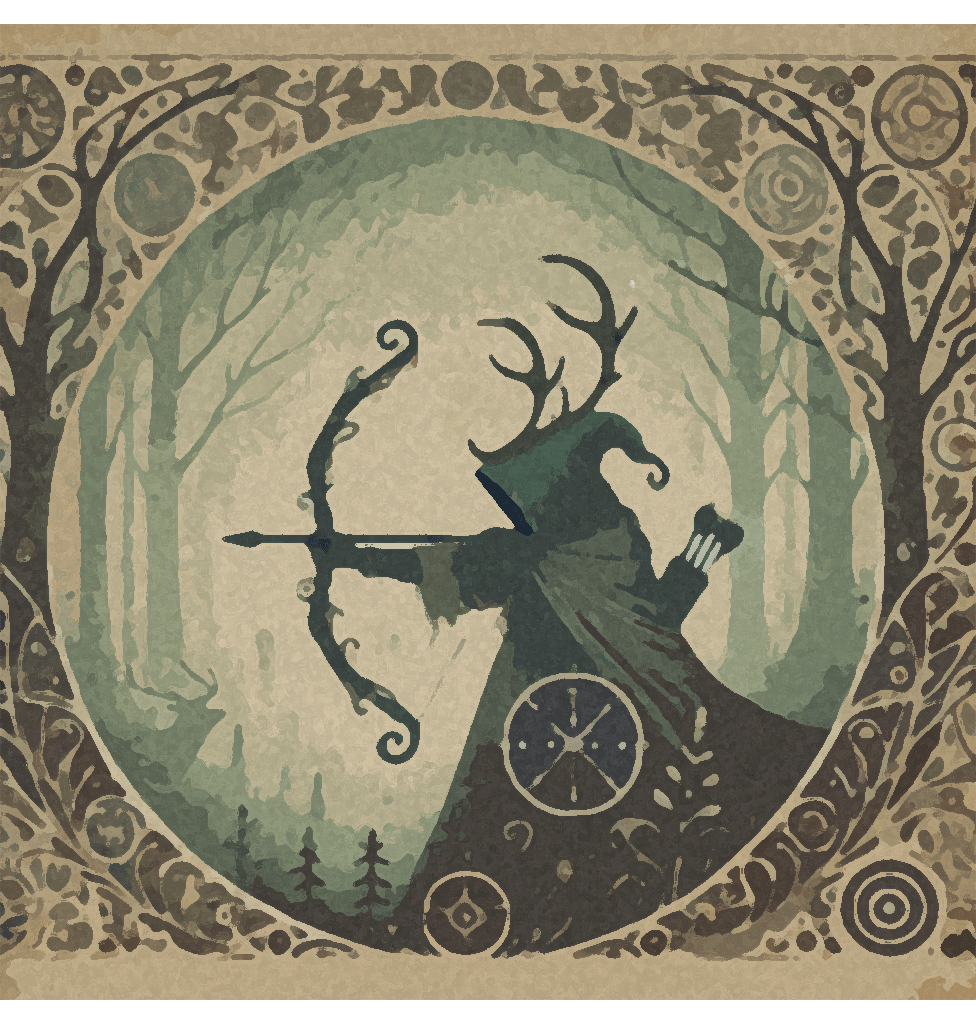
“Guide us, Lord of the Greenwood, protector of the downtrodden, to live in harmony with your sacred law. May we find strength in the wild and wisdom in its mysteries, walking your paths with reverence and trust.”
“Lord of the Greenwood, send your messengers to seek the lost and the worthy. Open the forest’s embrace to those in need and silence the cries of oppression. Let justice move like a whisper through the leaves, guiding all to your feast.
“O Lord, hear the call of those burdened by sorrow. Let your forest paths be a sanctuary, your companions be a guiding light, and your wisdom a balm to the troubled heart. May all who seek you find solace beneath your branches.”
“Under your boughs, we gather, Lord of the Greenwood. May this feast remind us of the harmony of creation, where all are equal and none go hungry. Teach us to share our bread, our burdens, and our joy with those in need.”
“We come to you, Lord of the Greenwood, unburdened by lies, with hearts laid bare. Hear our struggles, see our despair, and grant us the strength to walk the path of redemption and renewal, trusting in your balance.”
“O generous Lord, you who give so freely, teach us to do the same. May your gifts inspire us to restore harmony and serve others. In your bounty, we find purpose; in your wisdom, we find peace.”
 The Witch's and Druids Den
Leave a comment